Late-night summary:
1 - Adjusted the company’s Nostr relay.
2 - Adjusted the company’s Pixelfed instance.
3 - Reviewed and organized all meeting minutes.
3 - Optimized server health and load.
Overall result: positive.


ℑ𝔫 𝔤𝔦𝔯𝔲𝔪 𝔦𝔪𝔲𝔰 𝔫𝔬𝔠𝔱𝔢 𝔢𝔠𝔠𝔢 𝔢𝔱 𝔠𝔬𝔫𝔰𝔲𝔪𝔦𝔪𝔲𝔯 𝔦𝔤𝔫𝔦
Links Medium Substack YouTube LinkedIn Reddit Flickr pablomurad@pm.me pmurad@disroot.orgPablo News
Pablo MuradLate-night summary:
1 - Adjusted the company’s Nostr relay.
2 - Adjusted the company’s Pixelfed instance.
3 - Reviewed and organized all meeting minutes.
3 - Optimized server health and load.
Overall result: positive.
maybe its time to improve the code -> https://chess.pablomurad.com/
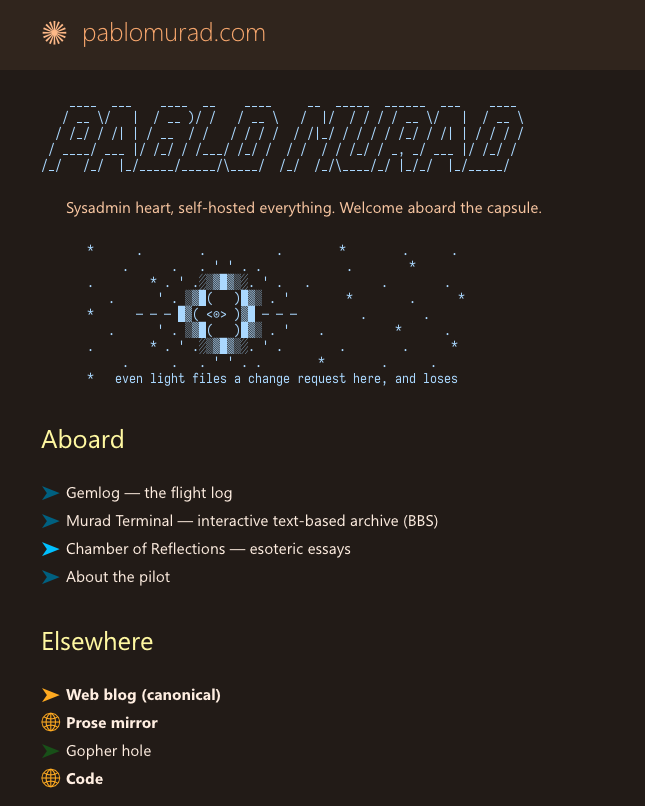
Making a mirror of my site on Gopher and Gemini was cool.
But setting up the email server on Gemini was incredible.

This update is really cool, it has icons for the different networks :D I had no idea!
Updating soju 0.9.0 → 0.10.1
Where’s the changelog?
🥹
Why are banking solutions in Brazil so terrible? It’s hard to find a good system that actually helps with financial management.
😂
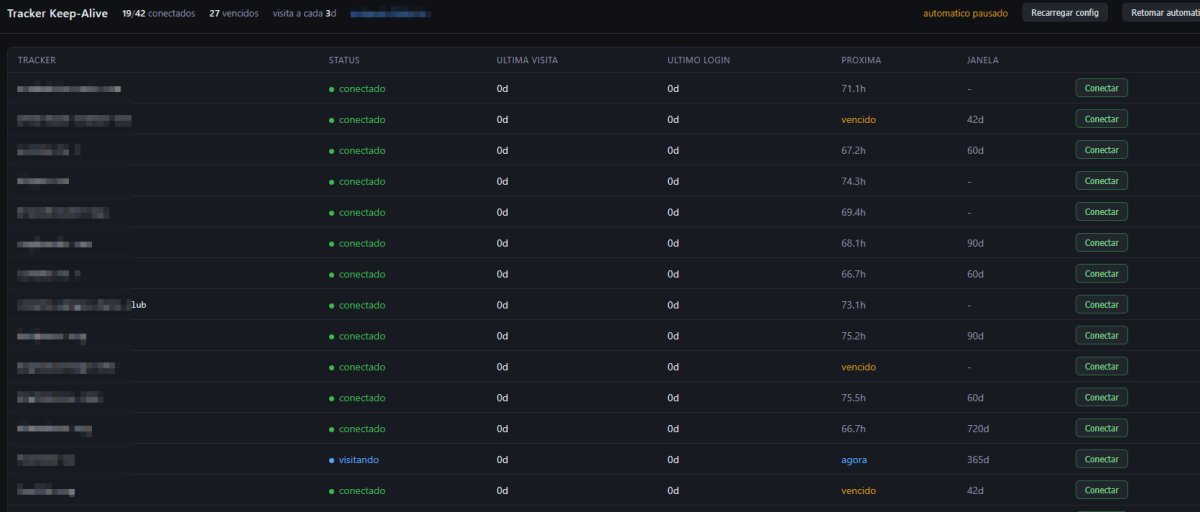
One of my biggest problems is keeping accounts active on private trackers. But I’m solving that now. This application keeps activity going on the trackers so the account doesn’t get deactivated.
There’s no repo link yet, and I haven’t even uploaded it anywhere. It’s basically a prototype of a prototype.
https://library.pablomurad.com contains 47 million words, and it would take an average of 16 years to read it all, spending 6 hours a day at the computer.
I love private trackers. Torrenting is life. But there’s one thing that really gets on my nerves: the level of consistency they require. You have to stay active and connected for certain periods, otherwise you risk losing your account. But today I’m going to solve that. 🥵
And while I’m at it, I invite you to check out https://library.pablomurad.com 🤩
why dont you work?
And does it work? No.
At least, NOT YET.

3 -
The narrative layer came on top of that. I wrote fictional documents that can appear naturally among the real material and used a per-visitor seed to vary some paths without turning the story into something random or incoherent. In the end, the system is much simpler than it looks: text files, a few import scripts, a small SQLite database, and a server that returns pages with almost no interface at all. The whole site is still basically what the Web has always done best: black text, a white background, and blue links.
2 -
So I started with a collection of text files linked to one another through hyperlinks. I wrote a small parser to interpret those references and a minimal server to serve everything as HTML. When the number of documents started to grow, I wrote importers to convert texts from encyclopedias, dictionaries, and other open sources into the same format, and began using SQLite only as an index to store IDs, links, and relationships without having to scan thousands of files on every request.
1 -
The idea started with two things I already found interesting. One was working with connected notes, something I had already been exploring in Obsidian: one text leading to another, cross-references, and information that starts to make more sense once you begin to see the relationships between things. The other came when I found Joshua Barretto’s /void project. It was created as a trap for crawlers, generating page after page linked together, but what interested me was not the anti-bot function. It was the feeling of entering a text and realizing you could keep following links indefinitely. I started wondering what would happen if, instead of meaningless text, it contained a story and part of human knowledge itself.